

Library Catalogue
| Item type | Current library | Collection | Shelving location | Call number | Status | Barcode | |
|---|---|---|---|---|---|---|---|
 BOOKs
BOOKs
|
. | MPP SECTIO | General Stacks | 338.19 MCM (Browse shelf(Opens below)) | Available | 35282 |
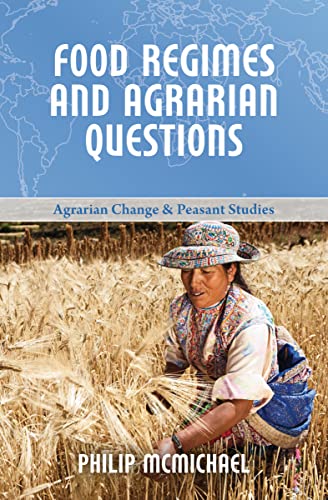
ICAS Agrarian Change and Peasant Studies Series (pp. vii-viii) Acknowledgements (pp. ix-x) Preface (pp. xi-xii) Chapter 1 The Food Regime Project (pp. 1-20) The food regime project is an ongoing analysis by scholars and activists of the political geography of the global food system. At each end of extensive food supply chains producers and consumers are increasingly aware of the global reach of the twenty-first-century food system (Patel 2007). Producers, ranging from contract farmers through migrant and plantation workers to smallholders dispossessed in the name of global food system efficiencies, are keenly aware of how their labor, resources and habitats serve consumers elsewhere. Consumers, dining along the global food chain, from hamburger to beefsteak, are increasingly confronted with disparities between food from somewhere... Chapter 2 Historical Forms of the Food Regime (pp. 21-40) Like capitalism, the food regime takes various historical forms. Indeed capitalism itself is a food regime, insofar as its reproduction depends on the provisioning of foodstuffs necessary to the (economical) reproduction of its labor force. This has involved the conversion of agriculture and food to commodity relations, which, in addition to cheapening food, also incorporate agricultures and foods into investment strategies. As of recently, these strategies include speculating in agri-food futures with inflationary effects. In the unfolding of these trends the accumulation dynamics attending particular food regime episodes are essential thresholds. Regime breakdown coincides with transition to a new accumulation... Chapter 3 The Corporate Food Regime (pp. 41-61) While each food regime has its own profile and role in underwriting power, the unifying thread is food’s contribution to capital accumulation via state system structuring. The food regime combines definition of and access to food resources with forms of market disposal that enhance power relations — through strategic provisioning of social classes and states and/or by displacing producers unable to compete with subsidized or monopolized market power. The latter has been the centrepiece of the corporate food regime (McMichael 2005). Historically, the rise and consolidation of capital has depended centrally on food — as a bio-political or a processing... Chapter 4 Food Regimes and the Agrarian Question (pp. 62-83) The agrarian question is a centrepiece of agrarian studies. Urban revolutionaries posed it at the turn of the twentieth century as a political question concerning the allegiances of the European peasantry. Of immediate concern was the question of whether and to what extent capitalist relations were eroding pre-capitalist rural landed property, and how this might contribute to an urban-rural worker alliance. It has since become synonymous with analysis of class transformations in the countryside, from the point of view of the capitalization of land. This chapter qualifies this approach to the agrarian question by resituating it in a world-historical context,... Chapter 5 Food Regime Reformulations (pp. 84-108) Returning to the food regime project, this chapter explores possibilities of broadening dimensions of the “food regime.” A principal distinction to make is between identifying food regime moments (periods of accumulation and associated transitions), and using food regime analysis to identify significant relationships and contradictions in the political history of capital across space and time, as this chapter illustrates. As such, the food regime concept invokes the commodity as relation (rather than as object), with definite geo-political, financial, social, ecological, and nutritional relations at significant historical moments. The East Asian region has been a consequential part of the food regime... Chapter 6 Crisis and Restructuring (pp. 109-130) The patterning of food regimes is represented, phenomenally, as a succession of regulatory structures organizing the relations of production and circulation of food. Such regulatory structures represent episodes of accumulation dynamics governed by patterns of expansion and crisis. Each regime anchors in a specific form of accumulation, which we can characterize, simply, as extensive, intensive, and financial forms respectively. These forms have conditioned geopolitical and institutional relationships premised on the deepening commodification of agriculture and food. Each food regime episode, then, is a successive part of an evolving historical conjuncture — the age of industrial agriculture. While each regime is... Chapter 7 The Food Regime and Value Relations: Which Values? (pp. 131-158) This final chapter opens up the value question with respect to food regimes. Food regime analysis has been framed by capital-centrism. Such analysis has underscored the significance of agriculture as a source of raw materials and food upon which industry and its labor force, and the exercise of state power, have depended. Nevertheless, it has offered a one-sided narrative of the making of the modern world. This resonates with James Scott’s point that in maize culture corn is more than its grain, given the corn crop’s multiple uses and symbolic value (1998: 295; and see Baker 2013). Analogously, the food... Glossary (pp. 159-164) References (pp. 165-188) Index (pp. 189-196)
Co-published by: Kumarian.