

Library Catalogue
| Item type | Current library | Shelving location | Call number | Materials specified | Status | Notes | Barcode | |
|---|---|---|---|---|---|---|---|---|
 BOOKs
BOOKs
|
. | Circulation Counter | 347.077 STE (Browse shelf(Opens below)) | PB | Available | Recommended by Mr. Harsha N | 40754 |
Foreword -
Preface -
Part I Introduction:
1:Summary -
2:Foundations -
Part II Unjustified Performance:
3:Performance -
4:Reversal -
5:Theory -
6:Practice -
Part III Conditional Performance:
7:Conditions -
8:Contract -
Part IV Intervention in Another's Affairs:
9:Discharge -
10:Necessity -
Part V Property and Trusts:
11:Things -
12:Equity: General -
13:Equity: Restitution -
14:Improvements -
Part VI Wrongdoing:
15:Wrongs -
16:Profits -
17:Damages -
Part VII Countervailing Reasons:
18:Defences -
19:Illegality -
Part VIII Apologia:
20:Conclusion.
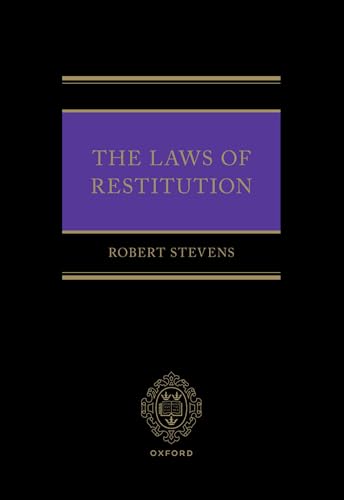
In The Laws of Restitution, Robert Stevens seeks to show that there is no unified law of restitution or unjust enrichment. This is in contrast to the traditional view of restitution which has long been thought to be reducible to a single "unjust enrichment".
The author proposes that there are instead (depending on how you count them) seven or eight different kinds of private law claim, none of which have anything important in common one with another, that have been grouped together by commentators. Few of these claims have anything to do with enrichment, and what is restituted differs between them. Like all private law claims, those gathered here concern (in)justice between individuals, but they have no further unity. Many of them are not based upon an agreement or a wrong, but that negative feature has no utility. As such, Stevens argues that "restitution" or "unjust enrichment" should cease to be discussed as unified areas of law.
In this work, Stevens identifies and describes the various reasons for "restitution" that any properly constructed system of private law ought to recognise. He also explains how the law of restitution relates to, and is bound up with, areas of contract, torts, equity, and property law.