
Library Catalogue
| Item type | Current library | Call number | Materials specified | Status | Notes | Barcode | |
|---|---|---|---|---|---|---|---|
 BOOKs
BOOKs
|
. | 378.1 DRE (Browse shelf(Opens below)) | HB | Not For Loan | 30535 | ||
|
BOOKs
|
. | 378.1 DRE-2 (Browse shelf(Opens below)) | HB | Available | Donated by Vice Chancellors Office, NLSIU | 37617 | |
|
BOOKs
|
. | 378.1 DRE-3 (Browse shelf(Opens below)) | HB | Available | Donated by Vice Chancellors Office, NLSIU | 37618 |

|

|

|

|

|

|
||
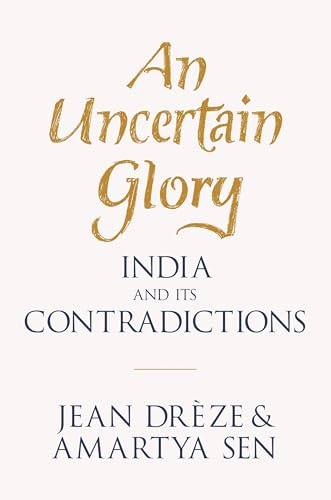
| 364.106 MCC Transnational organized crime : | 364.168 MON Financial crime and corporate misconduct : | 364.168 PAL Countering economic crime : | 378.1 DRE An uncertain glory : India and its contradictions / | 942.01 SEM Perceptions of the prehistoric in Anglo-Saxon England : | 954.0358 MUL Empire, politics and the creation of the 1935 India Act : |
Includes bibliographical references (pages 373-412) and indexes.
A new India? -- Integrating growth and development -- India in comparative perspective -- Accountability and corruption -- The centrality of education -- India's health care crisis -- Poverty and social support -- The grip of inequality -- Democracy, inequality and public reasoning -- The need for impatience.
When India became independent in 1947 after two centuries of colonial rule, it immediately adopted a firmly democratic political system, with multiple parties, freedom of speech, and extensive political rights. Maintaining rapid as well as environmentally sustainable growth remains an important and achievable goal for India. Two of India's leading economists argue that the country's main problems lie in the lack of attention paid to the essential needs of the people, especially of the poor, and often of women. In the long run, even the feasibility of high economic growth is threatened by the underdevelopment of social and physical infrastructure and the neglect of human capabilities.