
Search the Library Catalogue
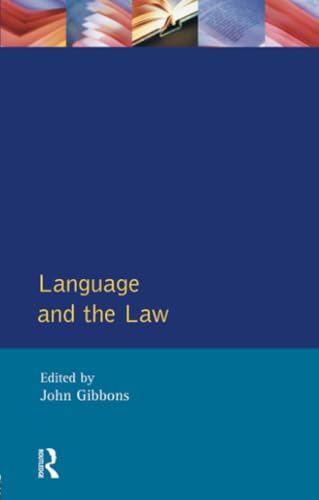
Image from Amazon.com
Language and the law
Publication details: London Longman Group 1994Description: 476p xivISBN:- 9780582101456
- 340.14 GIB-2 GIB-2
Contents:
Table of Contents;
Part 1: Language constructing law;
Introduction, John Gibbons;
1. The language of the law, Yon Maley
2. Accident and absolute liability in anthropology, Laurence Goldman
3. Orality, literacy, and performativity in Anglo-Saxon wills, Brenda Danet and Bryna Bogoch
4. Cognitive structuring in legislative provisions, Vijay Bhatia
5. Ideological exchanges in British magistrate courts, Snadra Harris
6. Video depositions: linguistic endorsement and caveats, Bethyl A. Pearson and Rebecca White Berch
7. Lawyer's response to language constructing law, Margaret O'Toole
Part 2: Language and disadvantage before the law
Introduction, John Gibbons
8. Cross-examining children in criminal courts: child welfare under attack, Mark Brennan
9. Interactional styles in the courtroom: an example from northern Australia, Michael Walsh
10. A case of communicative clash: Aboriginal English and the legal system, Diana Eades
11. Addressing social issues through linguistic evidence, William Labov and Wendell A. Harris
12. Lawyer's response to language and disadvantage before the law, John Carroll
Part 3: Forensic linguistics
Introduction, John Gibbons
13. Auditory and acoustic analysis in speaker recognition, Francis Nolan
14. The limitations of voice identification, Alex Jones
15. Forensic analysis of personal written texts: a case study, Robert Eagleson
16. Computers, statistics and disputed authorship, Wilfred Smith
17. Powerful evidence for the defence: an exercise in forensic discourse analysis, Malcolm Coulthard
18. Confidentiality of linguistic material: the case of Aboriginal land claims, Jane Simpson
19. Lawyer's response to forensic linguistics, Dyson Heydon
Bibliography;
Index
| Item type | Current library | Call number | Status | Barcode | |
|---|---|---|---|---|---|
 BOOKs
BOOKs
|
. | 340.14 GIB-2 (Browse shelf(Opens below)) | Available | 15793 |
Browsing . shelves Close shelf browser (Hides shelf browser)

|

|

|

|

|

|

|
||
| 340.115 TRE The sociology of law : Classical and contemporary perspectives / | 340.115 TYL Why people obey the law | 340.14 GAN Legal language, legal writing and general english | 340.14 GIB-2 Language and the law | 340.14 GOO Legal discourse : Studies in linguistics, rhetoric and legal analysis | 340.19 WRI Judicial decision making : | 340.2 The Oxford handbook of comparative law / |
Table of Contents;
Part 1: Language constructing law;
Introduction, John Gibbons;
1. The language of the law, Yon Maley
2. Accident and absolute liability in anthropology, Laurence Goldman
3. Orality, literacy, and performativity in Anglo-Saxon wills, Brenda Danet and Bryna Bogoch
4. Cognitive structuring in legislative provisions, Vijay Bhatia
5. Ideological exchanges in British magistrate courts, Snadra Harris
6. Video depositions: linguistic endorsement and caveats, Bethyl A. Pearson and Rebecca White Berch
7. Lawyer's response to language constructing law, Margaret O'Toole
Part 2: Language and disadvantage before the law
Introduction, John Gibbons
8. Cross-examining children in criminal courts: child welfare under attack, Mark Brennan
9. Interactional styles in the courtroom: an example from northern Australia, Michael Walsh
10. A case of communicative clash: Aboriginal English and the legal system, Diana Eades
11. Addressing social issues through linguistic evidence, William Labov and Wendell A. Harris
12. Lawyer's response to language and disadvantage before the law, John Carroll
Part 3: Forensic linguistics
Introduction, John Gibbons
13. Auditory and acoustic analysis in speaker recognition, Francis Nolan
14. The limitations of voice identification, Alex Jones
15. Forensic analysis of personal written texts: a case study, Robert Eagleson
16. Computers, statistics and disputed authorship, Wilfred Smith
17. Powerful evidence for the defence: an exercise in forensic discourse analysis, Malcolm Coulthard
18. Confidentiality of linguistic material: the case of Aboriginal land claims, Jane Simpson
19. Lawyer's response to forensic linguistics, Dyson Heydon
Bibliography;
Index