
NLSUI OPAC header image
Amazon cover image
Image from Amazon.com

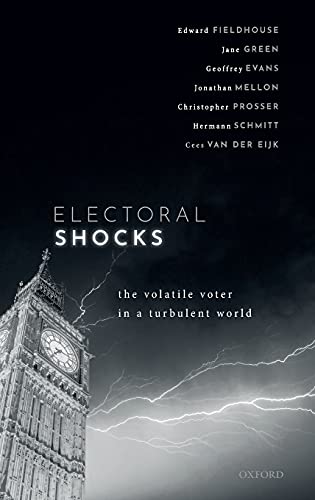
Electoral shocks : the volatile voter in a turbulent world / Edward Fieldhouse, Jane Green, Geoffrey Evans, Hermann Schmitt, Christopher Prosser, Jonathan Mellon, Cees van der Eijk.

By: Contributor(s): Publisher: New York : Oxford University Press, 2019Edition: New productDescription: pages cmContent type:
  • text
Media type:
  • unmediated
Carrier type:
  • volume
ISBN:
  • 9780198800583
  • 9780198800590
Online resources: Summary: "This book offers a novel perspective on British eElections, focusing on the importance of increasing electoral volatility in British elections, and the role of electoral shocks in the context of increasing volatility. It demonstrates how shocks have contributed to the level of electoral volatility, and also which parties have benefited from the ensuing volatility. It follows in the tradition of British Election Study books, providing a comprehensive account of specific election outcomes-the General Elections of 2015 and 2017-and a more general approach to understanding electoral change. We examine five electoral shocks that affected the elections of 2015 and 2017: the rise in EU immigration after 2004, particularly from Eastern Europe; the Global Financial Crisis prior to 2010; the coalition government of the Conservatives and the Liberal Democrats between 2010 and 2015; the Scottish Independence Referendum in 2014; and the European Union Referendum in 2016. Our focus on electoral shocks offers an overarching explanation for the volatility in British elections, alongside the long-term trends that have led us to this point. It offers a way to understand the rise and fall of the UK Independence Party (UKIP), Labour's disappointing 2015 performance and its later unexpected gains, the collapse in support for the Liberal Democrats, the dramatic gains of the Scottish National Party (SNP) in 2015, and the continuing period of tumultuous politics that has followed the EU referendum Referendum and the General Election of 2017. It provides a new way of understanding electoral choice in Britain, and beyond, and a better understanding of the outcomes of recent elections"-- Provided by publisher.
Star ratings
    Average rating: 0.0 (0 votes)
Holdings
Item type Current library Status Barcode
Open Access Books - Publishers . Available OABP272
Open Access Books - Publishers . Available OABP273
Open Access Books - Publishers . Available

"This book offers a novel perspective on British eElections, focusing on the importance of increasing electoral volatility in British elections, and the role of electoral shocks in the context of increasing volatility. It demonstrates how shocks have contributed to the level of electoral volatility, and also which parties have benefited from the ensuing volatility. It follows in the tradition of British Election Study books, providing a comprehensive account of specific election outcomes-the General Elections of 2015 and 2017-and a more general approach to understanding electoral change. We examine five electoral shocks that affected the elections of 2015 and 2017: the rise in EU immigration after 2004, particularly from Eastern Europe; the Global Financial Crisis prior to 2010; the coalition government of the Conservatives and the Liberal Democrats between 2010 and 2015; the Scottish Independence Referendum in 2014; and the European Union Referendum in 2016. Our focus on electoral shocks offers an overarching explanation for the volatility in British elections, alongside the long-term trends that have led us to this point. It offers a way to understand the rise and fall of the UK Independence Party (UKIP), Labour's disappointing 2015 performance and its later unexpected gains, the collapse in support for the Liberal Democrats, the dramatic gains of the Scottish National Party (SNP) in 2015, and the continuing period of tumultuous politics that has followed the EU referendum Referendum and the General Election of 2017. It provides a new way of understanding electoral choice in Britain, and beyond, and a better understanding of the outcomes of recent elections"-- Provided by publisher.