

Library Catalogue
| Item type | Current library | Shelving location | Call number | Materials specified | Status | Notes | Barcode | |
|---|---|---|---|---|---|---|---|---|
 BOOKs
BOOKs
|
. | General Stacks | 342.81029 MEY (Browse shelf(Opens below)) | PB | Available | Recommended by Prof. Dr. Arun K Thiruvengadam | 39396 |

|

|

|

|

|

|

|
||
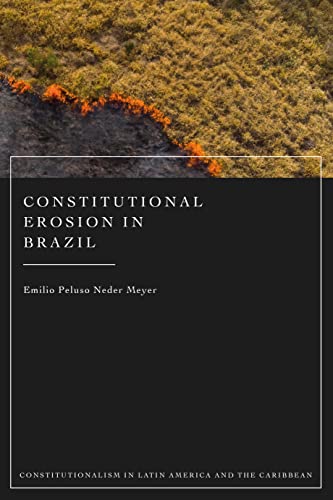
| 342.73087 ANC Scientific evidence and equal protection of the law / | 342.730873 MOR Race law stories / | 342.73088 HUQ The Collapse of Constitutional Remedies / | 342.81029 MEY Constitutional erosion in Brazil : progresses and failures of a constitutional project / | 342.850973 GIL Civil rights stories / | 343 BHU-2 Courting the people : | 343 ESP The consumer welfare hypothesis in law and economics : towards a synthesis for the 21st century |
Includes bibliographical references and index.
Introduction : Defining Brazil's constitutional erosion -- Transitional constitutionalism : judicial and military attempts at controlling a transition -- Social-democratic constitutionalism : neoliberal unconstitutional politics and socio-economic rights -- Institutional and personal judicial guarantees : judges, inequality and politics -- Judges and courts destabilising constitutionalism -- Subverting the rule of law : the military vs the milícias -- Eroding Brazilian constitutionalism -- Moderating powers? : military and judges in Brazilian constitutionalism -- Digital constitutionalism : WhatsApp elections and fake news -- Constitutional resilience against erosion : responses provided for by the 1988 Constitution.
"This book provides a fascinating analysis of a single jurisdiction, Brazil, and accounts for both the successes and the failures of its most recent constitutional project, inaugurated by the Constitution of 1988. It sets out the following aspects of the constitutional development and erosion: - the different phases of the promised transition from military rule to a 'social-democratic constitutionalism'; - the obstacles to democratisation derived from the absence of true institutional reforms in the judicial branch and in the civil-military relationship; - the legal and social practices which maintained a structure that obstructed the emergence of an effective social-democracy, such as the neoliberal pattern, the acceptance in the political field of unlawful organisations, such as the milícias, and the way the digital revolution has been harming the formation of democratic sovereignty. Situating Brazil in the global context of the revival of authoritarianism, it details the factors which are common to the third wave of democratisation reflux. Accounting for those aspects, particular to the Brazilian jurisdiction, it shows that there is a tension in the Brazilian constitution. On the one hand, such constitutionalism was renewed by democratic pressure on governments to undertake social politics since 1988. On the other hand, it retained authoritarian practices through the hands of diverse institutions and political actors. By exploring the ideas of constitutional erosion and collapse, as well as democratic, social and digital constitutionalism, the book presents a comparative analysis of Brazil and other jurisdictions, including the United States, South Africa, and Peru"-- Provided by publisher.