
Search the Library Catalogue
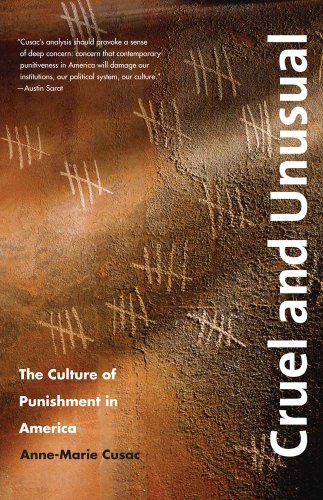
Image from Amazon.com
Cruel and Unusual : Look Inside Also Available: Cruel and Unusual / Anne-Marie Cusac
Publication details: New Haven Yale University press 2009Description: xii. 318 pages 22 cmISBN:- 9780300168013 (Paperback)
- 364.60973
Contents:
Summary: Scandals at Abu Ghraib and Guantanamo signal alarming changes in America’s attitudes toward criminals, punishment, and democratic ideals
The statistics are startling. Since 1973, America’s imprisonment rate has multiplied over five times to become the highest in the world. More than two million inmates reside in state and federal prisons. What does this say about our attitudes toward criminals and punishment? What does it say about us?
This book explores the cultural evolution of punishment practices in the United States. Anne-Marie Cusac first looks at punishment in the nation’s early days, when Americans repudiated Old World cruelty toward criminals and emphasized rehabilitation over retribution. This attitude persisted for some 200 years, but in recent decades we have abandoned it, Cusac shows. She discusses the dramatic rise in the use of torture and restraint, corporal and capital punishment, and punitive physical pain. And she links this new climate of punishment to shifts in other aspects of American culture, including changes in dominant religious beliefs, child-rearing practices, politics, television shows, movies, and more.
America now punishes harder and longer and with methods we would have rejected as cruel and unusual not long ago. These changes are profound, their impact affects all our lives, and we have yet to understand the full consequences.
Acknowledgments;
Introduction: American Living in a Time of Punishment;
1. When Punishment Is the Subject, Religion Is the Predicate;
2 "A Heart Is Not Wholly Corrupted": Revolution, Religion, Punishment;
3. Reforming the Reforms;
4 Punishment Creep;
5. Vigilantism and Progressivism;
6 The Devilish Generation;
7 Flogging for Jesus;
8 Pain Becomes Valuable Again;
9 Pop Culture and the Criminal Element;
10 Stunning Technology;
11. The Return to Restraint;
12 Abu Ghraib, USA;
Epilogue: A Little Good News;
Notes;
Index.
| Item type | Current library | Shelving location | Call number | Materials specified | Status | Notes | Date due | Barcode | |
|---|---|---|---|---|---|---|---|---|---|
 BOOKs
BOOKs
|
. | General Stacks | 364.60973 CUS (Browse shelf(Opens below)) | PB | Checked out | Recommended by Mr. Kunal Ambasta | 09.02.2026 | 39894 |
Acknowledgments;
Introduction: American Living in a Time of Punishment;
1. When Punishment Is the Subject, Religion Is the Predicate;
2 "A Heart Is Not Wholly Corrupted": Revolution, Religion, Punishment;
3. Reforming the Reforms;
4 Punishment Creep;
5. Vigilantism and Progressivism;
6 The Devilish Generation;
7 Flogging for Jesus;
8 Pain Becomes Valuable Again;
9 Pop Culture and the Criminal Element;
10 Stunning Technology;
11. The Return to Restraint;
12 Abu Ghraib, USA;
Epilogue: A Little Good News;
Notes;
Index.
Scandals at Abu Ghraib and Guantanamo signal alarming changes in America’s attitudes toward criminals, punishment, and democratic ideals
The statistics are startling. Since 1973, America’s imprisonment rate has multiplied over five times to become the highest in the world. More than two million inmates reside in state and federal prisons. What does this say about our attitudes toward criminals and punishment? What does it say about us?
This book explores the cultural evolution of punishment practices in the United States. Anne-Marie Cusac first looks at punishment in the nation’s early days, when Americans repudiated Old World cruelty toward criminals and emphasized rehabilitation over retribution. This attitude persisted for some 200 years, but in recent decades we have abandoned it, Cusac shows. She discusses the dramatic rise in the use of torture and restraint, corporal and capital punishment, and punitive physical pain. And she links this new climate of punishment to shifts in other aspects of American culture, including changes in dominant religious beliefs, child-rearing practices, politics, television shows, movies, and more.
America now punishes harder and longer and with methods we would have rejected as cruel and unusual not long ago. These changes are profound, their impact affects all our lives, and we have yet to understand the full consequences.