

Library Catalogue
| Item type | Current library | Collection | Shelving location | Call number | Materials specified | Status | Notes | Barcode | |
|---|---|---|---|---|---|---|---|---|---|
 BOOKs
BOOKs
|
. | Reference | Circulation Counter | 346.03 MOR (Browse shelf(Opens below)) | HB | Not For Loan | Recommended by Dr. Gayathri D. Naik | 40526 |

|
||
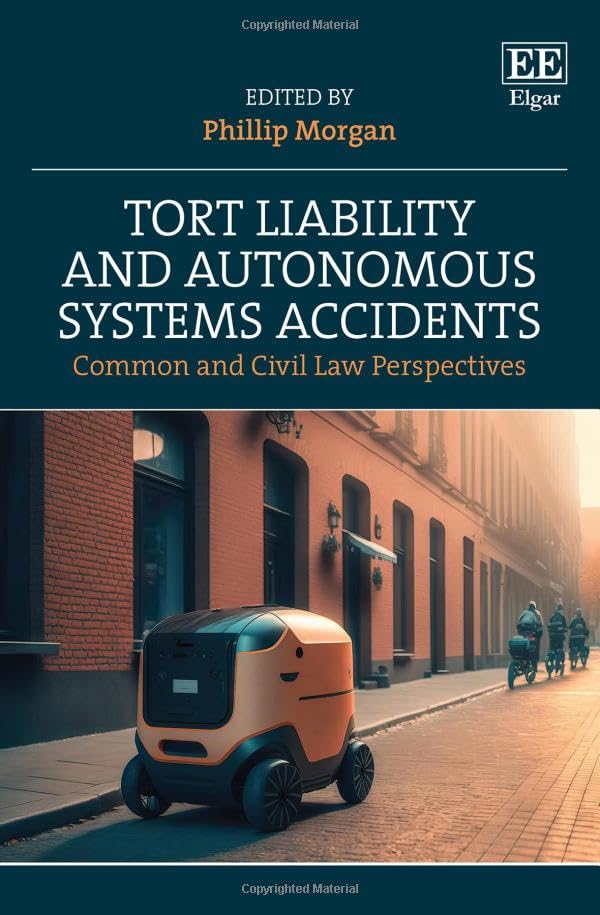
| 346.03 MOR Tort liability and autonomous systems accidents : common and civil law perspectives / |
Includes bibliographical references and index.
1 Tort Liability and Autonomous Systems Accidents – Challenges and Future Developments , Phillip Morgan -
2 Liability for Damage Caused by Artificial Intelligence – Some Food for Thought and Current Proposals, Jan De Bruyne and Orian Dheu -
3 AI Systems and the Issue of Liability in the European and National Regulatory Strategies, Erica Palmerini -
4 AI-Generated Torts, Ryan Abbott -
5 Civil Liability Applicable to Artificial Intelligence: A Preliminary Critique of the European Parliament
Resolution of 2020, Henrique Sousa Antunes -
6 Liability for Complex Systems: The Challenge of Robotic Technology in Private Law, Attila Menyhárd -
7 Artificial Intelligence and Medical Decision-Making: Wind of Change for Medical Malpractice Liability and Insurance? Özgün Çelebi and Ayşegül Buğra Şar -
8 Autonomous AI Torts: A Comparative Law and Economics Approach, Mitja Kovac -
9 Civil Liability all at Sea: The Challenges of Unmanned Cargo Ships, Simon Baughen -
10 Robotics Regulation and Liability Issues Concerning Robotic Technologies in the Oil and Gas Sector, Kyriaki Noussia and Maria Glynou -
Index.
Autonomous systems driven by artificial intelligence (AI) technologies have significant potential for increased productivity and improved safety in many sectors, but it is inevitable that some accidents will occur. The law needs an adequate way to respond to these scenarios and compensate those wrongfully injured. This comprehensive book examines the unique difficulties that autonomous systems create for existing accident compensation systems founded on tort, and proposes solutions.
Its chapters question the adequacy of accident compensation systems designed around the human wrongdoer, or a human whose conduct can be attributed to a legal person, when the ''wrongdoer'' is an autonomous system. With a multi-jurisdictional approach, including both common and civil law perspectives, this book examines the many challenges that autonomous systems present in tort law and sets forth that tort lawyers will need to significantly adjust their thinking to face these challenges. Focus is given to proposals and developments at an EU level and finding solutions to the problems brought about by autonomous systems.
This insightful text will be of great value to both students, researchers and practitioners in tort law, accident compensation and AI. High tech companies, think tanks, consultancies and organisations interested in autonomous systems and accidents will also widely benefit from its expertise.
Description based in part on online surrogate; resource not consulted.