

Library Catalogue
| Item type | Current library | Shelving location | Call number | Materials specified | Status | Notes | Barcode | |
|---|---|---|---|---|---|---|---|---|
 BOOKs
BOOKs
|
. | REFERENCE SECTION | 342.0959 CRO (Browse shelf(Opens below)) | HB | Not For Loan | Recommended by Dr. Siddharth Narrain | 40570 |
1:Introduction -
Part I. The Palimpsest Constitution under Colonial Rule:
2:Laying the Foundations of Constitutional Legacies: War, Occupation, and Law -
3:Resisting the Legacies of Imposed Constitution-making: Codification, Martial Law, and Executive Safeguards -
Part II. The Palimpsest Constitution in the Post-colony:
4:Subverting Colonial Constitutional Legacies: Independence, Social Democracy, and a Coup -
5:Contesting the Postcolonial Constitution: Religion, Federalism, and Anti-constitutional Crimes -
6:Rejecting the Postcolonial Constitution: Socialist Legality, the Party, and People's Duties -
7:Scripting New Constitutional Legacies: Military Constitution-makers, Resistance, and Reform -
Part III. The Palimpsest Constitution between the Military and the Courts:
8:Coopting the Legacy of the Writs: The Supreme Court, Rights, and Judicial Independence -
9:Repurposing Legacies of Judicial Review: The Constitutional Tribunal, the Military, and the Coup -
10:Conclusion -
Appendix 1:Constitutional Ethnography -
Appendix 2:List of Characters.
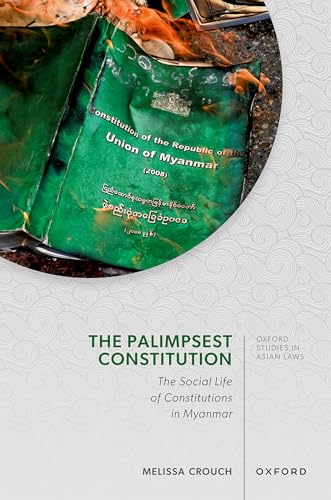
"This book explores how past constitutions matter in Myanmar. Since the mid-20th century, many former postcolonial states have engaged in multiple constitution-making exercises, with the turnover in written constitutions often due to authoritarian military coups or internal conflict. Yet despite the formal replacement of written constitutional texts, the ideas and practises of past constitutional texts often persist in society. Contributing to inquiries about the legacies of law, this book argues that constitutions are a palimpsest of past constitutional texts, ideas and practises, an accumulation of contested constitutional legacies. Through constitutional ethnography, the book explores the use of constitutional legacies from the colonial, postcolonial, socialist and military regimes in Myanmar. The book traces its modern constitutional history to show how people draw upon and repurpose constitutional legacies in affirmative and antagonistic ways in debates about constitutional reform. In contemporary Myanmar, the military insists on the endurance of its 2008 Constitution, while pro-civilian actors resist military rule through alternative constitution-making endeavours that draw heavily upon past efforts to enshrine civilian rule, democracy and federalism. The book demonstrates how contestation over the palimpsest constitution - the ongoing life of the legacies of past constitutional texts - is central to the struggle for constitutional democracy as civilian rule in Myanmar"-- Provided by publisher.