

Library Catalogue
| Item type | Current library | Shelving location | Call number | Materials specified | Status | Notes | Barcode | |
|---|---|---|---|---|---|---|---|---|
 BOOKs
BOOKs
|
. | General Stacks | 920 RAM-2 (Browse shelf(Opens below)) | HB | Available | Recommended by Dr. Manpreet Singh Dhillon | 40645 |
Author's Note -
List of Abbreviations -
Introduction -
PART I: Becoming an Engineer:
1. From Halli to Nagara -
2. Becoming an Engineer -
3. Becoming an Officer -
4. Poona Circles -
5. Transforming Irrigation in the Deccan -
6. Poona's All-Rounder -
7. In the Land of the Nizams -
PART II: Becoming a Statesman:
8. The Land of Your Birth'-
9. Reservoir of Hopes -
10. At the Helm -
11. From Universal Education to University -
12. Manufactured in Mysore -
13. A Dewan at Work -
PART III: On the National Stage:
14. Setting Sail -
15. Among the Politicians -
16. Critics, and Bhadravati Again -
17. Reclaiming the Metropolis -
18. Constitutional Adventures -
19. An Engineer among the Economists -
20. Rivers Gear -
21. The Motor of Progress -
22. Mentor to Manufacturers -
23. An Ageing Gadfly in the New India -
Epilogue: Engineering a Nation -
Notes -
Acknowledgements -
Index.
WINNER OF THE KAMALADEVI CHATTOPADHYAY NIF BOOK PRIZE 2025
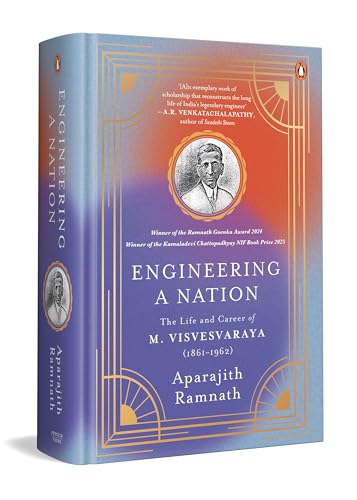
Mokshagundam Visvesvaraya (1861–1962) was arguably the most famous Indian engineer of the twentieth century. And yet he was also much more. To this day, much in India bears the imprint of Visvesvaraya’s work—not only as civil engineer, but also as public administrator, constitutional analyst and development thinker. Sugarcane farmers in Maharashtra and Karnataka, picknickers in the Brindavan Gardens alongside the Krishnarajasagara dam near Mysore, and city dwellers across the country who enjoy a piped water supply are all partaking of Visvesvaraya’s legacy. So are students in Bengaluru’s Indian Institute of Science and Mumbai’s Institute of Chemical Technology, consumers who swear by Mysore Sandal Soap, and anyone who has lived through Independent India’s Five-Year Plans.
Visvesvaraya was an early proponent of economic planning and rapid, large-scale industrialization, which he believed were essential for national development. Most of all, he was an ardent technocrat: a believer in the power of science and technology to solve society’s most pressing problems. In his time, his ideas were both lauded and criticised. Technocratic visions are once more at the centre of public discourse today: as in Visvesvaraya’s day, they hold much promise, but also have important limitations.
In Engineering a Nation, Aparajith Ramnath delves into a wide range of sources to paint a balanced picture of a man who has come to be regarded as a national icon. Throughout, he explores the professional and intellectual relationships that shaped Visvesvaraya, and highlights the historical context in which he worked. To explore Visvesvaraya’s life, the book argues, is to understand the emergence of the Indian nation itself.