

Library Catalogue
| Item type | Current library | Shelving location | Call number | Materials specified | Status | Notes | Barcode | |
|---|---|---|---|---|---|---|---|---|
 BOOKs
BOOKs
|
. | General Stacks | 320.6 WEI (Browse shelf(Opens below)) | PB | Available | Recommended by Prof. Sony Pellissery & Dr. Devyani Pande | 40655 |
First edition published by Pearson Education, Inc. 1992. Sixth edition published by Routledge 2017.
Includes bibliographical references and index.
Part I. Introduction to Public Policy Analysis:
1. Preview -
2. What is Policy Analysis? -
3. Toward Professional Ethics -
Part II. Conceptual Foundations for Problem Analysis:
4. Efficiency and the Idealized Competitive Model -
5. Rationales for Public Policy: Market Failures -
6. Rationales for Public Policy: Other Limitations of the Competitive Framework -
7. Rationales for Public Policy: Distributional and Other Goals -
8. Limits to Public Intervention: Government Failures -
9. Policy Problems as Market and Government Failures: Regulating Platforms -
Part III. Conceptual Foundations for Solution Analysis:
10. Correcting Market and Government Failures: Generic Policies -
11. Adoption -
12. Implementation -
13. Government Provision: Drawing Organizational Boundaries -
Part IV. Doing Policy Analysis:
14. Gathering Information for Policy Analysis -
15. Landing on Your Feet: Organizing a Policy Analysis -
16. Case Study: The Canadian Pacific Salmon Fishery -
17. Cost-Benefit Analysis: Assessing Efficiency -
18. Public Agency Strategic Analysis: Identifying Opportunities for Increasing Social Value -
Part V. Conclusion:
19. Doing Well and Doing Good –
Author index –
Subject index.
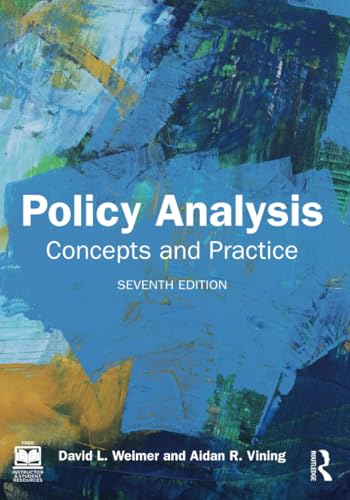
"Often described as a public policy "bible," Weimer and Vining remains the essential primer it ever was. Now in a thoroughly revised seventh edition, Policy Analysis provides a strong conceptual foundation of the rationales for and the limitations to public policy. It offers practical advice about how to do policy analysis, and goes a bit deeper to demonstrate the application of advanced analytical techniques through the use of case studies. Updates to this edition include: An all-new introductory case on corporate taxation Consideration of addiction as a rationale for public policy Discussion of public policy issues related to platforms and intermediation, especially to digital service delivery Updated discussion of information gathering from the perspectives of internal and external validity An updated British Columbia salmon fishery case The textbook is supported by online materials for instructors, including suggestions for and examples of course policy projects, a project assessment template, sample instructions to students for preparing policy reports, as well as discussion questions and answers for each chapter. Cases that have been removed in the seventh edition remain available on the book's webpage. Policy Analysis remains a comprehensive, serious, and rich introduction to policy analysis for students in public policy, public administration, and business programs"-- Provided by publisher.


