

NLSUI OPAC header image
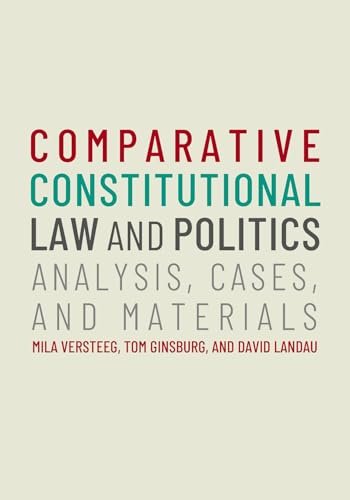
Amazon cover image
Image from Amazon.com

Comparative constitutional law and politics : analysis, cases, & materials / Mila Versteeg, Tom Ginsburg, David Landau.

By: Contributor(s): Publisher: New York : Oxford University Press, [2025]Description: xxxviii, 857 pages illustrations 26 cmContent type:
  • text
ISBN:
  • 9780197760499
Subject(s): DDC classification:
  • 342 VER 23/eng/20250404
Contents:
Constitutions, Constitutional Law, and Constitutionalism -- Constitution-Making -- Constitutional Change -- Courts And Constitutional Review -- The Separation of Powers -- Emergencies -- Federalism and the Territorial Organization of Power -- An Overview of Constitutional Rights -- Pluralism -- Equality and Non-Discrimination -- Economic and Social Rights -- Elections and Democracy.
Summary: "This textbook takes a new approach to the study of comparative constitutional law, suitable for law and social science courses at graduate or undergraduate levels. First, it is interdisciplinary and seeks to integrate state-of-the-art literature and caselaw from comparative constitutional law with insights from social science. It uses quantitative evidence to identify trends in constitutional texts and practices. Second, it is global in scope, recognizing that constitution-making and constitutional interpretation are increasingly transnational practices. This textbook includes many cases and judicial decisions. However, it situates those decisions in their social and political contexts and includes excerpts from scholarly works, as well as detailed explanations and citations. The textbook aims to broaden the field of comparative constitutional law far beyond the usual suspects. The reader will find examples not only from North America and Europe, but also from understudied jurisdictions in Africa, Asia, and Latin America. This textbook has 14 chapters. Chapter 1 introduces the foundational concepts of constitutions and constitutionalism, while Chapters 2 and 3 look at constitution-making and constitutional change. Chapters 5, 6, and 7 consider issues related to state structure - the horizontal separation of powers, states of emergency, and federalism. Chapter 8 introduces key overarching issues in rights interpretation, while Chapters 9 through 12 cover selected rights issues: freedom of speech, pluralism, equality, and economic and social rights. Chapter 13 discusses key issues related to elections, voting, and the protection of democracy, while Chapter 14 looks at the many ways in which constitutions interact with international law"-- Provided by publisher.
Star ratings
    Average rating: 0.0 (0 votes)
Holdings
Item type Current library Shelving location Call number Materials specified Status Notes Barcode
BOOKs . New Arrival - Display Area 342 VER (Browse shelf(Opens below)) PB Not For Loan Recommended by Prof. Dr. Arun K Thiruvengadam 40731

Includes bibliographical references and index.

Constitutions, Constitutional Law, and Constitutionalism -- Constitution-Making -- Constitutional Change -- Courts And Constitutional Review -- The Separation of Powers -- Emergencies -- Federalism and the Territorial Organization of Power -- An Overview of Constitutional Rights -- Pluralism -- Equality and Non-Discrimination -- Economic and Social Rights -- Elections and Democracy.

"This textbook takes a new approach to the study of comparative constitutional law, suitable for law and social science courses at graduate or undergraduate levels. First, it is interdisciplinary and seeks to integrate state-of-the-art literature and caselaw from comparative constitutional law with insights from social science. It uses quantitative evidence to identify trends in constitutional texts and practices. Second, it is global in scope, recognizing that constitution-making and constitutional interpretation are increasingly transnational practices. This textbook includes many cases and judicial decisions. However, it situates those decisions in their social and political contexts and includes excerpts from scholarly works, as well as detailed explanations and citations. The textbook aims to broaden the field of comparative constitutional law far beyond the usual suspects. The reader will find examples not only from North America and Europe, but also from understudied jurisdictions in Africa, Asia, and Latin America. This textbook has 14 chapters. Chapter 1 introduces the foundational concepts of constitutions and constitutionalism, while Chapters 2 and 3 look at constitution-making and constitutional change. Chapters 5, 6, and 7 consider issues related to state structure - the horizontal separation of powers, states of emergency, and federalism. Chapter 8 introduces key overarching issues in rights interpretation, while Chapters 9 through 12 cover selected rights issues: freedom of speech, pluralism, equality, and economic and social rights. Chapter 13 discusses key issues related to elections, voting, and the protection of democracy, while Chapter 14 looks at the many ways in which constitutions interact with international law"-- Provided by publisher.