

Library Catalogue
| Item type | Current library | Shelving location | Call number | Materials specified | Status | Notes | Barcode | |
|---|---|---|---|---|---|---|---|---|
 BOOKs
BOOKs
|
. | Circulation Counter | 342.02 CHR (Browse shelf(Opens below)) | PB | Available | Recommended by Prof. Dr. Arun K Thiruvengadam | 40769 |

|
|

|

|

|
|
|
||
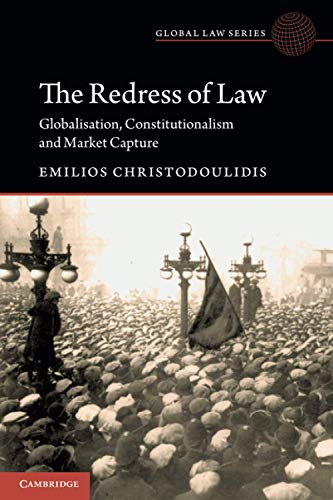
| 342 JAI-2 Principles of administrative law / | 342 JAI-3 Principles of administrative law / | 342 LEY Administrative law facing the future : Old constraints and new horizons | 342.02 CHR The redress of law : globalisation, constitutionalism and market capture / | 342.0853 PRO - 1 Right To Information Act, 2005 (22 of 2005) | 342.0853 PRO - 2 Right To Information Act, 2005 (22 of 2005) | 342.0853 PRO - 3 Right To Information Act, 2005 (22 of 2005) |
Introduction -
Part I. Political Phenomenology:
1.1. Hannah Arendt and the theory of the bourgeois public sphere -
1.2. Simone Weil, necessity and courage -
1.3. The phenomenology of work -
1.4. Toward a critical phenomenology -
Part II. Political Constitutionalism:
2.1. Constituent power and the constitutional distinction -
2.2. Constitutionality -
2.3. Labour, solidarity and the social constitution -
2.4. Constitutionalism adrift -
Part III. Market Constitutionalism:
3.1. Market trajectories -
3.2. 'Total market' thinking -
3.3. Europe's social market and the disembedding of labour protection -
3.4. The deep commodification of labour -
Part IV. Strategies of redress:
4.1 The constitutional situation -
4.2. Militant formalisms -
4.3. Constitution, autogestion, rupture -
4.4: Constitutionalising contradiction toward an open constitutional dialectic.
From a legal-philosophical point of view, The Redress of Law presents a critical analysis of a number of related doctrinal fields: constitutional, labour and EU Law. Focusing on the organisation and protection of work, this book asks what it means to protect work as an essential aspect of human (individual and collective) flourishing. This is an ambitious and highly sophisticated intervention in contemporary academic and political debates around a set of critically important questions connected to processes of globalisation and market integration. The author redefines the nature of legal and political thought in an age in which market rationality has exceeded its classic domain and has come to pervade the organization of social and political life. This restatement of critical legal theory is intended to defend the concept of constitutionalism and suggest new ways to deploy the law strategically.
Develops the concept of political constitutionalism
Explores interface of the legal system with the political and the economic systems
Explains phenomenology and critical theory as they apply to law