

Library Catalogue
| Item type | Current library | Shelving location | Call number | Materials specified | Status | Notes | Barcode | |
|---|---|---|---|---|---|---|---|---|
 BOOKs
BOOKs
|
NLS | Circulation Counter | 340.9 CHA-1 (Browse shelf(Opens below)) | HB | Available | Recommended by Mr. Jai Brunner | 40833 | |
|
BOOKs
|
NLS | Circulation Counter | 340.9 CHA-2 (Browse shelf(Opens below)) | HB | Available | Recommended by Mr. Jai Brunner | 40834 |
Introduction -
Section One: The Legal History of Colonial Rule in the South Asian Subcontinent and the Ontologization of ‘The Law’: The Problem and a Proposed Analytical Framework -
1:The History of British Colonial Rule in South Asia as a History of Legal Development -
2:Beyond Law and History: Naturalization and its Limits in Jurisprudential Inquiry -
3:Denaturalizing the Law: Historical Ontology as a Method / A Method for Historical Ontology
Section Two: Laws and the Land: Property and Revenue in the Discourse of the Company's India from 1757 to 1857 -
4:From Plassey to the Permanent Settlement in the Company’s Bengal: Property, Constitution, and a Historical Ontology of the Laws -
5:Beyond the Permanent Settlement: Property Discourse and Non-Zamindari Revenue Systems
Section Three: The Law and its Basic Elements: Rights as Realms and the Will of Juridical Persons in the Discourse of Classical Legal Thought in the Crown's India from 1857 to c.1920 -
6:Crown Rule and the Legalization of Property: Rights as Realms of Proprietary Interest -
7:The Private and the Public Will in the Indian Contract Act -
8:From Contract to the Nascent Anthropological Discourse about Status -
9:The Restitution of Conjugal Rights and the Nature of Marriage: Constituting the Subsystems of the (Religious) Personal Law as a Law of Status -
Conclusion -
Bibliography.
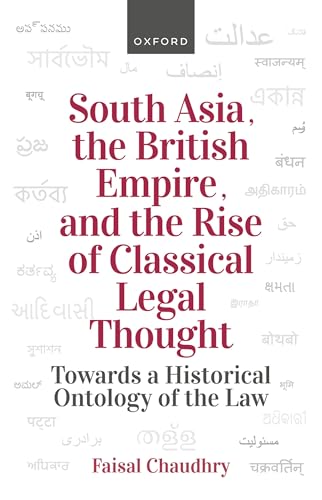
This book considers the legal history of colonial rule in South Asia from 1757 to the early 20th century. It traces a shift in the conceptualization of sovereignty, land control, and adjudicatory rectification, arguing that under the East India Company the focus was on 'the laws' factoring into the administration of justice more than 'the law' as an infinitely generative norm system. This accompanied a discourse about rendering property 'absolute' defined in terms of a certainty of controlling land's rent-and made administrable mainly as a duty of revenue payment—rather than any right of ostensibly physical dominion. Leaving property external to its ontology of 'the laws,' the Company's regime thus differed significantly from its counterparts in the Anglo-common-law mainstream, where an ostensibly unitary, physical, and disaggregable notion of the property right was becoming a stand in for a notion of legal right in general already by the late 18th century. Only after 1858, under Crown rule, did conditions in the subcontinent ripen for 'the law' to emerge as a purportedly free-standing institutional fact. A key but neglected factor in this transformation was the rise of classical legal thought, which finally enabled property's internalization into 'the law' and underwrote status and contract becoming the other key elements of the Raj's new legal ontology. Formulating a historical ontological approach to jurisprudence, the book deploys a running distinction between the doctrinal discourse of (the) law and ordinary-language discourse about (the) law that carries implications for legal theory well beyond South Asia.


