

NLSUI OPAC header image
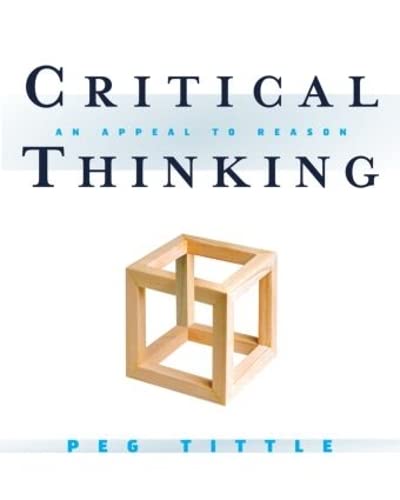
Amazon cover image
Image from Amazon.com

Critical thinking : an appeal to reason / Peg Tittle.

By: Publication details: New York : Routledge, 2011.Description: xiv, 442 p. : ill. (chiefly col.) ; 26 cmISBN:
  • 9780415997133 (hardcover)
  • 9780415997140 (pbk.)
  • 9780203841617 (ebook)
Subject(s): DDC classification:
  • 160 TIT 22
LOC classification:
  • BC177 .T536 2011
Contents:
Contents Chapter 1: Critical Thinking 1.1 What is critical thinking? 1.2 What is critical thinking not? Chapter 2: The Nature of Argument 2.1 Recognizing an Argument 2.2 Circular Arguments 2.3 Counterarguments 2.4 The Burden of Proof 2.5 Facts and Opinions 2.6 Deductive and Inductive Argument Chapter 3: The Structure of Argument 3.1 Convergent, Single 3.2 Convergent, Multiple 3.3 Divergent Chapter 4: Relevance 4.1 Relevance 4.2 Errors of Relevance Chapter 5: Language 5.1 Clarity 5.2 Neutrality 5.3 Definition Chapter 6: Truth and Acceptability 6.1 How do we define truth? 6.2 How do we discover truth? 6.3 How do we evaluate claims of truth? Chapter 7: Generalizations, Analogies, and General Principles 7.1 Sufficiency 7.2 Generalizations 7.3 Analogies 7.4 General Principles Chapter 8: Inductive Argument – Causal Reasoning 8.1 Causation 8.2 Explanations 8.3 Predictions, Plans, and Policies 8.4 Errors in Causal Reasoning Glossary Index
Star ratings
    Average rating: 0.0 (0 votes)
Holdings
Item type Current library Shelving location Call number Status Barcode
BOOKs . NAB Compactor 160 TIT (Browse shelf(Opens below)) Available 27576

Contents
Chapter 1: Critical Thinking
1.1 What is critical thinking?
1.2 What is critical thinking not?
Chapter 2: The Nature of Argument
2.1 Recognizing an Argument
2.2 Circular Arguments
2.3 Counterarguments
2.4 The Burden of Proof
2.5 Facts and Opinions
2.6 Deductive and Inductive Argument
Chapter 3: The Structure of Argument
3.1 Convergent, Single
3.2 Convergent, Multiple
3.3 Divergent
Chapter 4: Relevance
4.1 Relevance 4.2 Errors of Relevance
Chapter 5: Language
5.1 Clarity
5.2 Neutrality
5.3 Definition
Chapter 6: Truth and Acceptability
6.1 How do we define truth?
6.2 How do we discover truth?
6.3 How do we evaluate claims of truth?
Chapter 7: Generalizations, Analogies, and General Principles
7.1 Sufficiency
7.2 Generalizations
7.3 Analogies
7.4 General Principles
Chapter 8: Inductive Argument – Causal Reasoning
8.1 Causation
8.2 Explanations
8.3 Predictions, Plans, and Policies
8.4 Errors in Causal Reasoning
Glossary
Index