

Library Catalogue
| Item type | Current library | Call number | Status | Barcode | |
|---|---|---|---|---|---|
 BOOKs
BOOKs
|
. | 620.5 DAN (Browse shelf(Opens below)) | Available | 27689 |
Includes bibliographical references and index.
Content:
Part I. Introduction:
1. The nanotechnology challenge David A. Dana;
2. The five myths about nanotechnology in the current public policy debate: a science and engineering perspective Kimberly Gray;
Part II. Public Perceptions of Nanotechnology Risks:
3. Public regulation and the regulation of emerging technologies - the role of private politics Daniel Diermeier;
4. How scientific evidence links attitudes to behaviors James N. Druckman and Toby Bolsen; Part III. Meeting the Nanotechnology Challenge by Creating New Legal Institutions:
5. Toward risk-based, adaptive regulatory definitions David A. Dana;
6. The missing market instrument: environmental assurance bonds and nanotechnology regulation Douglas A. Kysar;
7. Conditional liability relief as an incentive for precautionary study David A. Dana;
8. Transnational new governance and the international coordination of nanotechnology oversight Gary E. Marchant, Kenneth W. Abbott, Douglas J. Sylvester and Lyn M. Gulley;
9. Labeling the little things Jonathan H. Adler;
10. Public nuisance: a potential common law response to nanotechnology's uncertain harms Albert C. Lin;
11. Enlarging the regulation of shrinking cosmetics and sunscreens Robin Fretwell Wilson;
12. Accelerating regulatory review John O. McGinnis;
13. Ethical issues in nanotechnology: persons and polity Laurie Zoloth;
Part IV. Where We Are Now - The Current Institutions for Nanotechnology Regulation:
14. An overview of the law of nanotechnology Fern O'Brian;
15. Regulatory responses to nanotechnology uncertainties Read D. Porter, Linda Breggin, Robert Falkner, John Pendergrass and Nico Jaspers..
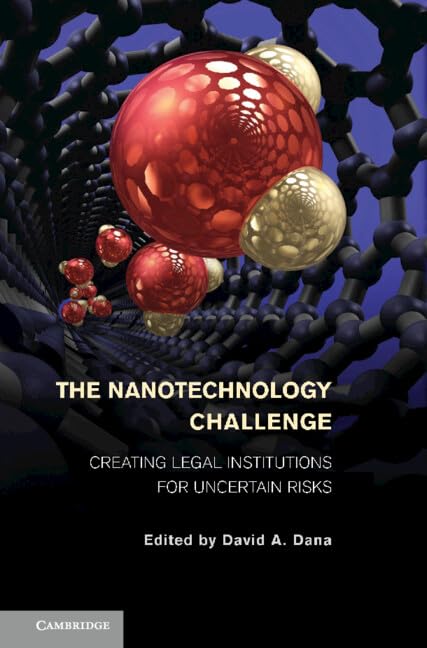
"This book is about nanotechnology, very tiny substances that are manipulated to act in all sorts of extraordinary ways, and that many think have or are about to usher in the next industrial revolution. The focus of the book is how society can continue to reap economic and other benefits from nanotechnology, while addressing the possible risk to human and the environment from nanotechnology. Leading scholars offer a range of solutions to the challenge of regulating nanotechnology in a way that allows for continued fast innovation worldwide while making certain we limit or avoid the possible harms from nanotechnology"-- Provided by publisher.