

Library Catalogue
| Item type | Current library | Shelving location | Call number | Materials specified | Status | Notes | Barcode | |
|---|---|---|---|---|---|---|---|---|
 BOOKs
BOOKs
|
. | REFERENCE SECTION | 342.02 JAC (Browse shelf(Opens below)) | HB | Available | Recommended by Prof. Dr. Arun K Thiruvengadam | 40650 |
1 Introduction: the comparative turn in constitutional theory and the crisis of democratic erosion - Gary Jacobsohn and Miguel Schor -
PART I CONSTITUTIONALISM AND DEMOCRATIC EROSION:
2 Illiberal constitutionalism: viable alternative or nemesis of the modern constitutional ideal? - Michel Rosenfeld -
3 Transitional justice, transitional constitutionalism and constitutional culture - Gábor Halmai -
4 Militant democracy and constitutional identity - Jan -Werner Müller -
5 Race and American constitutional exceptionalism - Mark A. Graber -
PART II CONSTITUTIONAL STRUCTURE AND RIGHTS:
6 American constitutional exceptionalism and democratic erosion - Miguel Schor -
7 What is judicial supremacy? - Stephen Gardbaum -
8 Federalism and constitutional theory - Stephen Tierney -
9 The constitutional significance of human dignity: what exactly? - Jacob Weinrib
10 Social rights in comparative constitutional theory - Jeff King
11 Text and democracy: theoretical approaches to religious liberty cases in the United States Supreme Court and the European Court of Human Rights - Howard Schweber -
12 Consensus, conflict, and complementarity: a global perspective on the freedom of expression - Ronald J. Krotoszynski Jr.
PART III CONSTITUTIONAL INTERPRETATION:
13 Legal pragmatism and comparative constitutional law- David Landau -
14 Beyond the principle of proportionality - Victor Ferreres Comella -
15 The unwritten constitution - Janet McLean -
PART IV CONSTITUTIONAL CHANGE:
16 Constitutional theory in a comparative context - Adrienne Stone and Lael K. Weis -
17 ‘We the people’, ‘oui, the people’ and the collective body: perceptions of
constituent power - Yaniv Roznai -
18 Amendment theory and constituent power - Mark Tushnet -
19 Theorising about formal constitutional change: the case of Latin America -Joel I. Colón-Ríos -
20 Anchoring and sailing: contrasting imperatives of constitutional revolution - Gary Jeffrey Jacobsohn -
21 Reception, context, and identity: a theory of cross-national jurisprudence - Heinz Klug –
Index.
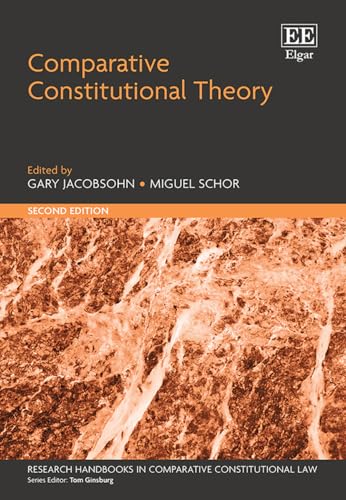
"This thoroughly revised Second Edition provides a refreshed overview of comparative constitutional law and theory. Expert authors investigate the recent proliferation of instances in which the practice of constitutionalism has been compromised by various forms of democratic erosion. New and updated chapters complement the first edition's illumination of key concepts in comparative constitutional theory with a specific focus on its connections to a rise in authoritarian rule. In the face of democratic backsliding, global authors underscore the question of design and investigate how constitutional governance can be enhanced to avert further democratic degradation. The Research Handbook is underpinned by an empirically based study of the core principles of constitutional practice within a cross-national context, including informative discussions on constitutionalism, fundamental rights, and constitutional identity. Notably, this book examines the degree to which illiberal constitutionalism has become an increasingly ominous presence in the (mal)functioning of political systems and acknowledges the pervasive condition of constitutional imperfection. Exploring distinctive constitutional realities, this accessible Research Handbook is a crucial resource for scholars and students of constitutional theory, comparative law, and constitutional and administrative law. It is also a vital read for those interested in constitutional design and interpretation"-- Provided by publisher.