
NLSUI OPAC header image
Amazon cover image
Image from Amazon.com

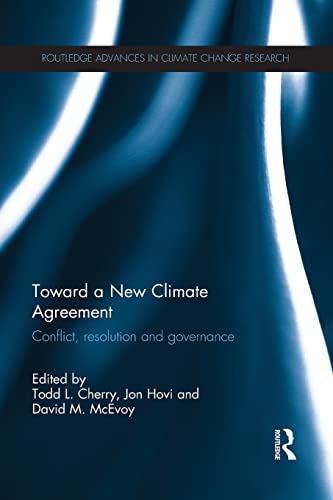
Toward a new climate agreement : Conflict, resolution and governance

By: Contributor(s): Publication details: London Routledge 2014Description: 295p xixISBN:
  • 9781138656567
Subject(s): DDC classification:
  • 341.762000 CHE
Contents:
Table of Contents PART I: CONFLICT: BARRIERS TO A NEW AGREEMENT 1. Observations from the climate negotiations in Durban, South Africa 2. Does fairness matter in international environmental governance 3. Formation of climate agreements: The role of uncertainty and learning 4. Burden sharing in global climate governance 5. Negotiating to avoid ‘gradual’ versus ‘dangerous’ climate change: An experimental test of two prisoners’ dilemmas 6. U.S. climate policy and the shale gas revolution PART 2:RESOLUTION: PATHS TOWARD A NEW AGREEMENT 7. The role of inequality in international environmental agreements with endogenous minimum participation requirements 8. Climate policy coordination through institutional design: an experimental examination 9. Improving the design of international environmental agreements 10. Managing dangerous anthropogenic interference: decision rules for climate governance 11. Exclusive approaches to climate governance: More effective than the UNFCCC? 12. Bottom up or top down PART 3:GOVERNANCE: STRUCTURES FOR A NEW AGREEMENT 13. Rethinking the legal form and principles of a new climate agreement 14. Technology agreements with heterogenous countries 15. International guidance for border carbon adjustments to address carbon leakage 16. The effect of enforcement in the presence of strong reciprocity: an application of agent-based modeling 17. EU emissions trading: achievements, challenges, solutions 18. The EU’s quest for linked carbon markets: turbulence and headwind
Star ratings
    Average rating: 0.0 (0 votes)
Holdings
Item type Current library Call number Status Barcode
BOOKs . 341.762 CHE (Browse shelf(Opens below)) Available 31422

Table of Contents
PART I: CONFLICT: BARRIERS TO A NEW AGREEMENT 1. Observations from the climate negotiations in Durban, South Africa 2. Does fairness matter in international environmental governance 3. Formation of climate agreements: The role of uncertainty and learning 4. Burden sharing in global climate governance 5. Negotiating to avoid ‘gradual’ versus ‘dangerous’ climate change: An experimental test of two prisoners’ dilemmas 6. U.S. climate policy and the shale gas revolution PART 2:RESOLUTION: PATHS TOWARD A NEW AGREEMENT 7. The role of inequality in international environmental agreements with endogenous minimum participation requirements 8. Climate policy coordination through institutional design: an experimental examination 9. Improving the design of international environmental agreements 10. Managing dangerous anthropogenic interference: decision rules for climate governance 11. Exclusive approaches to climate governance: More effective than the UNFCCC? 12. Bottom up or top down PART 3:GOVERNANCE: STRUCTURES FOR A NEW AGREEMENT 13. Rethinking the legal form and principles of a new climate agreement 14. Technology agreements with heterogenous countries 15. International guidance for border carbon adjustments to address carbon leakage 16. The effect of enforcement in the presence of strong reciprocity: an application of agent-based modeling 17. EU emissions trading: achievements, challenges, solutions 18. The EU’s quest for linked carbon markets: turbulence and headwind